
1. Introduction: Why Web Analytics Is Stuck in the Past
Website analytics has not fundamentally changed in over a decade.
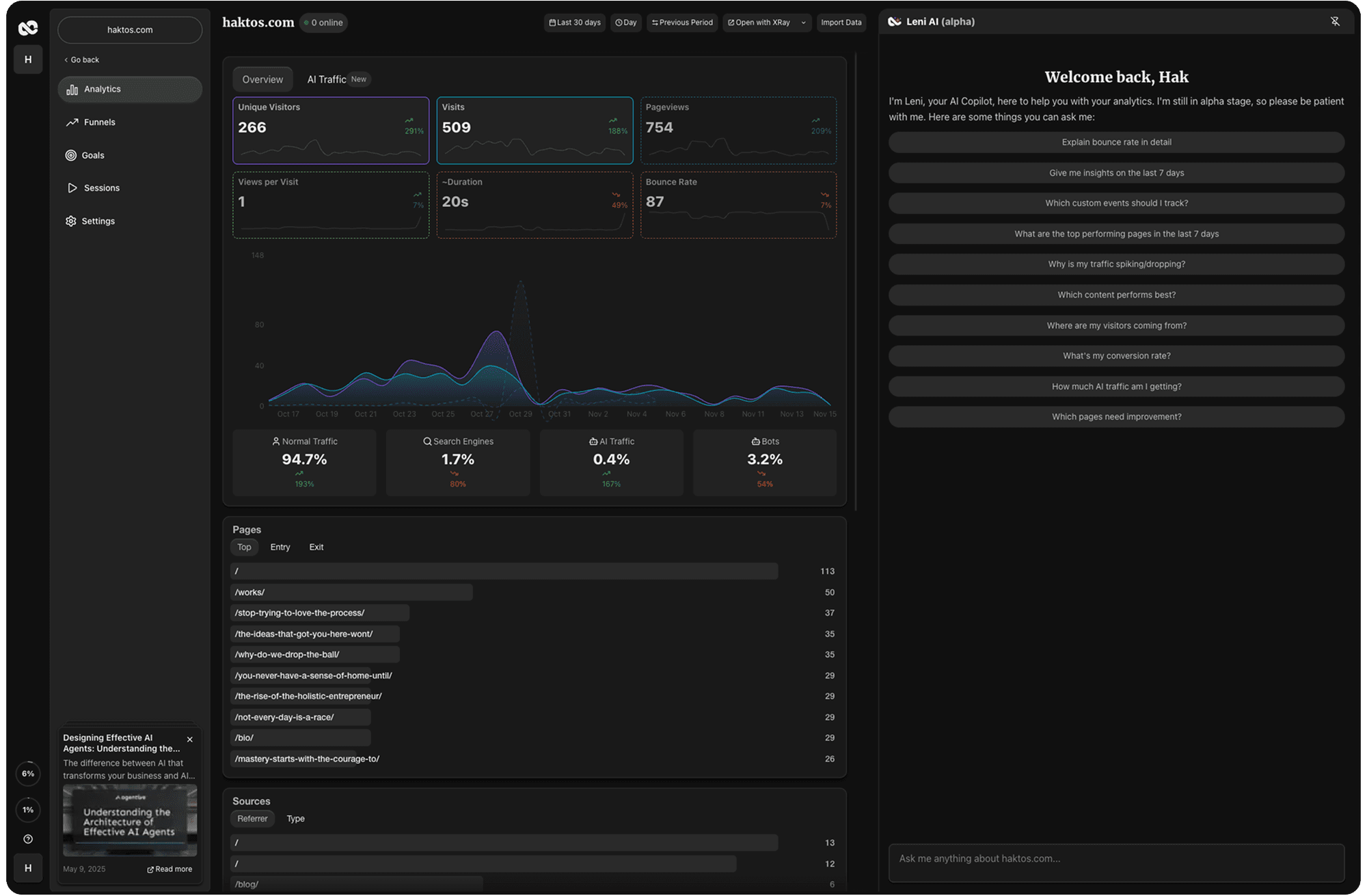
Despite new interfaces (dashboards - link to the other article), new branding, and new pricing models, most analytics tools - Google Analytics 4, Mixpanel, Plausible, Amplitude - still rely on the same core paradigm:
Collect data → Send it to a dashboard → Ask humans to interpret it → Hope insights translate into action.
This model is increasingly misaligned with how modern teams work and how quickly should businesses act on the data that they track and manage.
Product Managers, Growth Managers, Marketers, and Founders do not lack data.
They lack clarity, context, and speed.
This is where Embedded Analytics emerges - not as a feature, but as a new category of web intelligence.
2. The Current State of Website Analytics
The dominant analytics model today
Most website analytics platforms share the same structure:
- Centralized dashboards
- Aggregated metrics (sessions, bounce rate, conversions)
- Event-based tracking
- Post-hoc analysis
- Heavy configuration requirements
Even privacy-first tools such as Plausible Analytics or Matomo, just to name a couple, largely replicate the same experience, only with fewer metrics.
The core problem
The issue is not data accuracy or the KPIs themselves.
The issue is cognitive overhead.
Teams must constantly answer questions like:
- Which page element caused this drop?
- Where are the conversion "bottlenecks"?
- What changed after the last release?
- Why did conversions drop on mobile, but not desktop?
Dashboards rarely answer these questions directly and most often lead to solutions/fixes based on best guesses or inspiration. Either way, not an exact data -> interpretation -> solution -> outcome correlation.
3. The Hidden Cost of Dashboard-Centric Analytics
Analytics dashboards create friction, not insight
Working with the traditional analytics dashboards makes one:
- Leave the website
- Constantly switch context
- Interpret abstract charts
- Guess what happened on the actual page
This introduces three major inefficiencies:
- Time Loss – Insights require multiple tools, meetings and specialized people
- Interpretation Errors – Data "divorced" from the UI context
- Delayed Decisions – Analysis happens after the damage is done
The real cost to teams
For SMEs and SaaS companies, these aspects contribute to:
- Slower possibility for experimentation
- Missed UX issues
- Inefficient CRO efforts
- Over-reliance on “gut feeling”
This is especially problematic for lean teams, where the same person often owns product, growth, and marketing decisions.
4. What Is Embedded Analytics?
Definition: Embedded Analytics
Embedded Analytics refers to analytics that are directly integrated into the digital experience itself, rather than separated into external an external tool/environment.
In the context of website analytics, this means:
- Data visualized on top of the live website
- Metrics attached to actual page elements
- Insights available where decisions are made
Instead of asking:
“What happened on the homepage?”
You see:
“This button received 43% of clicks but caused a 12% drop in scroll depth.”
Directly on the page.
And in case anyone is wondering, no, this data and insights will not be available to anyone who visits the website. Only the website owners/admins will see the data, through a sign-up/login process.
5. Embedded Analytics vs Traditional Analytics Tools
| Aspect | Traditional Analytics | Embedded Analytics |
|---|---|---|
| Data Location | External dashboards | On the website itself |
| Context | Abstract | Visual & contextual |
| Time to Insight | High | Immediate |
| Learning Curve | Steep | Minimal |
| Collaboration | Fragmented | Shared, visual |
| Decision Speed | Slow | Fast |
Traditional tools tell you that something happened.
Embedded analytics shows you where, why and what action to take.
6. Why Embedded Analytics Is the Next Evolution of Web Intelligence
Web intelligence must be actionable
Modern teams need answers, not more reports coming from the same kind of data dashboards.
Embedded analytics aligns with how humans naturally reason:
- We understand visuals faster than tables
- We identify problems faster when put in context
- We act faster when the insight is obvious
From data analysis to decision intelligence
Embedded analytics represents a shift from:
- Analytics as reporting
- To analytics as decision support
This is particularly important in environments where:
- Deployment cycles are fast
- UX changes frequently
- Conversion optimization is continuous and even mandatory
7. Use Cases: How Embedded Analytics Transforms Daily Work
Example 1: Conversion Rate Optimization (CRO)
Traditional approach:
- Analyze funnel drop-offs
- Guess which element caused friction
- Run A/B tests blindly
Embedded analytics approach:
- See click-through, hover, and engagement data per clickable element
- Identify friction points instantly
- Optimize with data-backed confidence
Example 2: Content Performance & SEO
Instead of:
- Page-level bounce rates
You get:
- Scroll depth per section
- Engagement per heading
- CTA visibility impact
This directly improves on-page SEO, content structure, and UX signals.
8. Embedded Analytics for Product, Growth, and Marketing Teams
Product Managers
- Understand feature discoverability
- Validate UI changes without waiting for reports
- Reduce reliance on qualitative-only feedback
Growth Managers
- Identify conversion bottlenecks visually
- Optimize landing pages faster
- Align experimentation with real user behavior
Marketers
- See which CTAs actually work
- Optimize campaigns post-click
- Improve messaging clarity
Founders
- One source of truth
- No analytics "babysitting", nor exhaustive trainings
- Faster strategic decisions
9. Privacy, Performance, and the Post-Cookie Era
Analytics is changing—again
With:
- GDPR
- ePrivacy
- Cookie deprecation
- Consent fatigue
Analytics must be:
- Lightweight
- Privacy-compliant
- Transparent
Embedded analytics platforms like Sitelens are built with:
- Privacy-first tracking
- Minimal data collection
- No invasive profiling
This makes Sitelens a strong competitor, among the other privacy-first providers, for EU-based companies and privacy-conscious markets.
10. How Sitelens Redefines Embedded Website Analytics
What makes Sitelens different
Sitelens is, simply put, not “another analytics tool.”
It introduces:
- Visual, in-page analytics overlays
- Element-level interaction data
- Real-time insights, without the explicit need of data dashboards
- CMS-agnostic integration
- SME-focused usability
You do not analyze your website.
You look at it, with all the data intelligence layered on top.
Competitive positioning
Compared to:
- GA4 – Complex, abstract, time-consuming
- Mixpanel – Event-heavy, product-centric
- Plausible – Clean, but still dashboard-based and limited in capababilities
Sitelens delivers insight where your work actually happens.
Oh, and forgot to mention that there's also AI to it.
11. Embedded Analytics and the Rise of AI-First Decision Making
Why AI needs better data context
AI-powered recommendations are only as good as the data context they receive.
Embedded analytics provides:
- Spatial context
- Behavioral nuance
- Visual correlation
This enables future capabilities such as:
- Automated UX recommendations
- Predictive CRO suggestions
- AI-assisted design decisions
Embedded analytics is the foundation for the AI-native web intelligence.
12. SEO, CRO, and UX: Where Embedded Analytics Delivers the Most ROI
SEO benefits
- Improved dwell time
- Better content hierarchy
- Higher engagement signals
- Faster iteration on landing pages
CRO benefits
- Fewer blind tests
- Clear optimization targets
- Faster wins
UX benefits
- Reduced friction
- Clear usability insights
- Evidence-based design
13. Who Benefits Most from Embedded Analytics?
Embedded analytics is particularly valuable for:
- SaaS companies
- SMEs
- Start-ups
- Agencies
- Product-led businesses
- Content-heavy websites
Especially teams that:
- Aim to move fast
- Have limited analytics resources at their disposal
- Care about outcomes, not reports
14. The Future of Website Analytics: From Reports to Reality
The future of analytics is not:
- More metrics
- More dashboards (even if beautiful)
- More complexity
The future is:
- Less abstraction
- More clarity
- Instant insight
- Actionable intelligence
Embedded analytics is not a trend.
It is a correction.
15. Conclusion: From Observing Data to Acting on It
Website analytics should not slow teams down.
It should:
- Accelerate decisions
- Reduce uncertainty
- Improve outcomes
Embedded Analytics represents a fundamental shift - from observing behavior after the fact, to understanding it as and where it happens.
Sitelens is at the forefront of this shift.
Not by adding more data, but by putting insight exactly where it belongs:
on the website itself.
- 1. Introduction: Why Web Analytics Is Stuck in the Past
- 2. The Current State of Website Analytics
- The dominant analytics model today
- The core problem
- 3. The Hidden Cost of Dashboard-Centric Analytics
- Analytics dashboards create friction, not insight
- The real cost to teams
- 4. What Is Embedded Analytics?
- Definition: Embedded Analytics
- 5. Embedded Analytics vs Traditional Analytics Tools
- 6. Why Embedded Analytics Is the Next Evolution of Web Intelligence
- Web intelligence must be actionable
- From data analysis to decision intelligence
- 7. Use Cases: How Embedded Analytics Transforms Daily Work
- Example 1: Conversion Rate Optimization (CRO)
- Example 2: Content Performance & SEO
- 8. Embedded Analytics for Product, Growth, and Marketing Teams
- Product Managers
- Growth Managers
- Marketers
- Founders
- 9. Privacy, Performance, and the Post-Cookie Era
- Analytics is changing—again
- 10. How Sitelens Redefines Embedded Website Analytics
- What makes Sitelens different
- Competitive positioning
- 11. Embedded Analytics and the Rise of AI-First Decision Making
- Why AI needs better data context
- 12. SEO, CRO, and UX: Where Embedded Analytics Delivers the Most ROI
- SEO benefits
- CRO benefits
- UX benefits
- 13. Who Benefits Most from Embedded Analytics?
- 14. The Future of Website Analytics: From Reports to Reality
- 15. Conclusion: From Observing Data to Acting on It